Introduction
Romans 15:4
For whatever was written in earlier times was written for our instruction, so that through perseverance and the encouragement of the Scriptures we might have hope.
Some Old Testament passages are plain and simple narrative. That’s it. God is telling us in a straightforward manner what happened in the history of the children of Israel. It’s OK to LEARN from these passages. When we read the Old Testament, part of the learning process should include going after PRINCIPLES that will give us HOPE.
We must avoid spiritualizing passages as we are learning. What does it mean to ‘spiritualize’ a passage?
1). Interpreting the passage using a sanctified imagination.
2). Finding meaning in the scripture through the use of subjective symbolism and/or exaggeration.
3). Allegorizing a section of the Bible to fit something spiritual in our lives.
(Walls of Jericho – “what walls have you built in your life that need to crumble?”)
(David / Goliath – “are there giants in your life that you need to gain victory over?”)
We risk misinterpreting scripture when we spiritualize it, resulting in possibly missing the right meaning and application of it. We dishonor God by vandalizing His Word, making it say what He did not intend for it to say.
How can we accurately interpret what we’re reading and make accurate application of a passage to our lives? We must read a passage straightforwardly, studying it to find the author’s original intent. A vivid imagination is no way to properly discern what God is trying to communicate. Words have meaning and God has not given us His permission to mangle what He has said by using our wild creativity.
Historical Background – On-Ramp to Nehemiah
The Children of Israel were delivered from the hands of the wicked pharoah by amazing deeds of God in the story of the Exodus. The Lord made a covenant with His people and can be summarized by saying they would receive blessings if they obeyed God or they would be under a curse if they chose not to obey God. If they chose to break the covenant, other nations would force them into slavery (Deut. 28:32; Jer. 2:14-25).
In spite of God’s warnings, the Israelites repeatedly rejected God’s commands and were eventually carried away into captivity, being exiled from their homeland. The Assyrians in 722 BC deported the ten tribes of the Northern Kingdom and scattered all over their empire. Then the Babylonians destroyed Jerusalem (606-586 BC), carrying most of the people away to endure a 70 year captivity. It’s hard to look at the continued disobedience of the Israelites over all those years and wonder how they could have been so stupid because their constant theme of turning against God is strikingly similar to the way we are today.
This brings us to the events of Nehemiah.
Author
Ezra and Nehemiah was originally one book, most likely written by the scribe Ezra.
Themes of Ezra/Nehemiah
- The sovereign hand of God at work in keeping with His plan at His appointed times (see Ezra 1:1 – the Lord stirred up the spirit of King Cyrus; Nehemiah 2:8 – “the good hand of the Lord”).
- The emphasis and careful attention to the reading of God’s Word.
- A clear example of prayer, modeled by Nehemiah.
- God working through the obedience of Nehemiah and through his wrongly motivated enemies.
- The importance of the wall itself. It provided protection and separation. God’s people have always been called out to be holy, set apart for a special purpose. Ezra 8:28; 9:2.
Chapter 1 – The Distress of Jerusalem
Nehemiah, the son of Hacaliah, is the cupbearer to King Artaxerxes. Being a cupbearer was not a lowly state as some may believe, but rather a position of high esteem and honor. Not only was the cupbearer charged with tasting the king’s wine to make sure it was safe, he also had direct, frequent access to the king and thus had significant influence. It is because of this close relationship Nehemiah had with the king that he was granted such favor and authority by King Artaxerxes. Interestingly, he played an important role in the Feast of Tabernacles and also in the founding of a library. He was a legendary figure in Jewish literature.
The name Nehemiah means ‘comfort’; ‘consolation of Israel’. He was going to be used by God to give hope to the people of Israel.
Nehemiah was in Susa, known to be one of the three capitols of Persia. This was also the spring residence of the kings (Neh 2:1,month of Nisan). Susa is in Iran (Shush, Khuzestan Province, directly north of Kuwait and the Persian Gulf). Likely the burial place of the prophets Daniel and Jonah. ISIS is reported to have destroyed these historic tombs in 2014.
Time frame is the ‘twentieth year’, in the month of Chislev. That most likely refers to the 20th year of King Artaxerxes reign (see 2:1). The month of Chislev is 6 months earlier than Nisan in Nehemiah 1:2.
The brother of Nehemiah and some other men report on the condition of the city of Jerusalem (700 miles away, a 13-day walk) and the news is not good.
The remnant of people were in great distress.
They are considered as a reproach.
The wall of Jerusalem have been broken down.
The gates of the city have been burned.
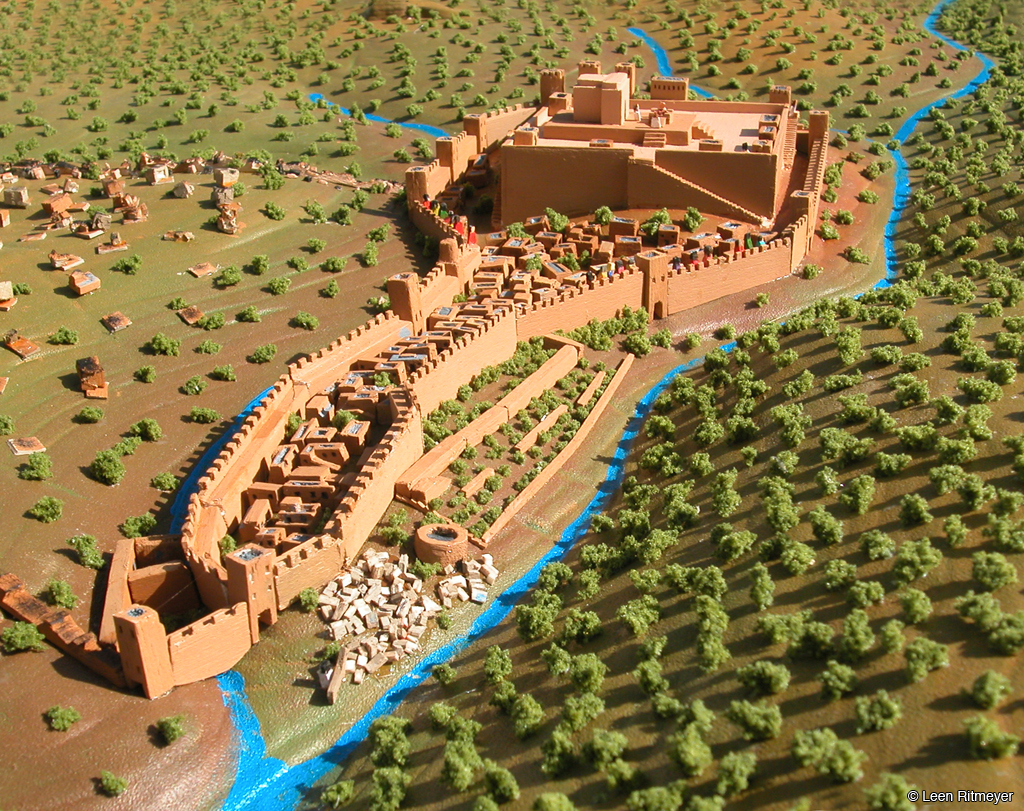
Nehemiah’s reaction to the news? He wept and mourned for days. He fasted and prayed. The attitude and content of this prayer is a model for us. Notice the following elements of the prayer:
1). It was immediate. Upon hearing the bad news about his people and his homeland, Nehemiah approached God.
2). It was a prayer accompanied with raw emotion. He wept and mourned as he prayed. Nothing rigid or pre-planned, just honest and authentic communication with God.
3). It was a constant prayer. Verse 6 says he prayed ‘day and night’. So severe was the plight of his people, and so burdened was Nehemiah, that short and hurried prayers would not suffice.
4). It was a prayer ascribing greatness to God. Nehemiah recites several of God’s attributes: the great and awesome God; a God who honors His covenant. Great and awesome is translated from the original Hebrew, meaning “awe-inspiring” and “stand in fear”.
5). It was a prayer of confession. He confesses the sins of Israel, beseeching the Lord to hear and grant compassion.
There is a deep concern within Nehemiah because of the condition of his people and their homeland. Any distress in the church and in the Christian community should bring us great concern.
Nehemiah’s reaction is one of immediate fasting and praying. This is a call to action for Christians to fast and pray (with weeping and mourning!) over the things that bring reproach upon the name of Christ.
Chapter 2 – Answered Prayer
Nehemiah, the cupbearer, takes wine to King Artaxerxes in the month of Nisan. His face apparently hadn’t shown his concern for his people and his homeland for all these months, or at least no one noticed. But on this day his countenance revealed there was something wrong. The king notices that Nehemiah is out of sorts and that he appears to be sad. Being sad or dissatisfied in the presence of the king was cause for fear because the happiness of the king’s subjects reflected the well-being of the whole kingdom. Showing any other emotion to the king could result in death. When he asks Nehemiah why he is sad, he tells him of the dire condition of Jerusalem.
Gates represented the life and vitality of a city since judicial and basic social interaction took place there. Burned gates represented the death of social life and the end of a community of people.
There is significance to Artaxerxes question to Nehemiah: “What would you request?” It shows that the king had a genuine concern for his cupbearer, indicating again that there was a closeness in their relationship. The king stood ready to remedy any issues with Nehemiah.
Nehemiah’s reaction to Artaxerxes is also very significant. He doesn’t answer the question immediately. First he prays to the God of heaven. This initial response shows us that he was relying upon the Lord to give him the right words to say. The passage does not say what Nehemiah prayed. It only says that he prayed to the God of heaven. He then responds to the king with honesty, pleading for his favor and requesting that he make a journey to Jerusalem to rebuild the city.
King Artaxerxes was happy to send Nehemiah, writing letters to the governors of the provinces to allow for legal and safe passage, and a letter to Asaph (the keeper of the forest) to provide building materials. To escort him to Jerusalem, the king also provided officers from the army and horsemen. Forests were carefully guarded back then because the lumber was a valuable commodity. These were all important factors at the beginning of Nehemiah’s project that didn’t go unnoticed by him. He recognized that God’s favor was upon him since the king had granted these things (2:8). God works through His servants to accomplish His will!
However, Sanballat and Tobiah were not pleased that Nehemiah had come to seek the welfare of his people and his city. Sanballat was the governor of Samaria and Tobiah was a leader from East of the Jordan, so they are no small figures in the story. Their goal was to interrupt and even sabotage what Nehemiah wanted to accomplish. There is always opposition when someone is trying to do God’s will!
Nehemiah spent three days figuring out what to do. Then he surveys the situation by viewing the southern end of the city, checking out the burnt and broken conditions of the wall. The true leader that Nehemiah is emerges out of his encouragement to the people: “Rise up and build! The God of Heaven will make us prosper!” Oftentimes, all it takes to get through the battle is an encouraging word from someone else, urging us to forge ahead.
Chapter 3 – Cooperation
Chapter 3 records a list of workers who participated in the repairing of the wall and the resetting of the city gate. What could possibly be beneficial to us in a passage like this? Remember 2 Timothy 3:16: “ALL scripture is God-breathed and profitable for teaching, reproof, correction and training in righteousness”
So what can we learn from this passage about fixing walls and gates?
1). “Many hands make for light work”. People working together toward a common goal is productive. Everyone benefits when everyone does their part.
2). People with diverse expertise, working together, will accomplish much. Notice their vocations: the high priest (v1); goldsmiths (v8, 31, 33); perfumers (v8); families of high officials; priests (v22, 28); temple servants (v26); merchants (32). These are people with various gifts and talents who bring their knowledge forward for the good of the whole. This is a case study in unity. A project of this magnitude required a general sense of unity or it would not be successful (Psalm 133:1).
3). Some people were not on board. There will always be people who are not committed (v5).
4). Women were involved in the work (v12). Heavy construction is just not for men. Both men and women have value in this type of project.
The rebuilding of the wall was no small undertaking. There was no room for laziness, argument or indecision. This was going to take the cooperation, diligence and commitment of many people.
Chapter 4 – Opposition
Nehemiah and the Jews faced opposition in the form of ridicule at first. Sanballat, the Horonite, was furious that the building of the wall was going forward. Horonite: someone from beth-Horon, in the region of the Samaritans.
What made Sanballat so angry about this? Consider the relationship between Jews and Samaritans:
- The area of Samaria was north of Jerusalem and inhabited by some of the people from Assyrian Empire (this empire existed from as early as 25th century BC until its collapse in 612 BC).
- The Assyrians intermarried with the Jewish people in that area and they became known as ‘half-breeds’, considered as neither fully Gentile nor fully Jewish.
- They adopted the Jewish religion, using only the Torah as their religious book, but combined it with their own system of polytheism.
- The division between the Jews and the Samaritians was a rift of bitterness that built and increased over a long period of time. It may have begun when King Josiah, in his reformation efforts, tore down all the altars of false worship and slaughtered the priests in the cities of Samaria (640-609 BC; 2 Kings 23:19-20).
- Samaritans would still pilgrimage to Jerusalem for certain ‘holy’ events, but were never allowed to participate because of their supposed non-Israelite heritage and divergent belief system (Ezra 4:23; Nehemiah 2:20).
New Testament Observations About the Samaritan People Group:
- Early in Jesus’s ministry, the disciples were told NOT to go into the cities of Samaria (Matthew 10:5-6).
- Jesus encountered a Samaritan woman and engaged her in conversations about true worship in John 4.
- We have the account of the ‘Good Samaritan’ in Luke 10:30-37.
- Out of the ten lepers that were cleansed by Jesus in Luke 17:11-19, the only one to come back and give thanks was a Samaritan.
- After His ressurrection, Jesus was specific in Act 1:8 for His witnesses to go to Jerusalem, Judea AND Samaria.
Nehemiah’s immediate reaction was to pray (v.4).






 Establish my footsteps in Your Word ~ Psalm 119:133