A Lesson on God’s Deliverance
Exodus 12:33-15:21
Sequence of Events
1). Egyptians send the Israelites out of the land (with silver, gold and clothing).
Six hundred thousand men (aside from women and children) left with their flocks and livestock.
2). God gave instructions to Moses regarding the consecration of the firstborn – “remember this day, for by a powerful hand the Lord brought you out of Egypt’ (13:3,9,14,16).
3). God led the people by way of the wilderness. They didn’t go the shortest way, which was by way of the Philistines because God said they might change their minds when they see war and want to return to Egypt.
4). God led them by a pillar of cloud by day and by and pillar of fire by night.
5). The Pharaoh and his Egyptians chased after them in the wilderness, catching up to them and pinning them against the Red Sea (14:9), resulting in their fear and terror (14:10-12).
6). Moses said, “Stand by and see the salvation of the Lord which He will accomplish for you today”, and then stretched out his staff over the Red Sea. The Lord then divided the water, allowing the children of Israel to cross to safety on dry land.
7). Pharaoh’s army pursued but were thrown into confusion (14:23-25). They realized that ‘God was fighting for Israel’ (v.25).
8). The pillars protected the people, and when they had all crossed to safety, Moses stretched out his staff over the sea again, and it closed in on the Pharaoh’s army, drowning every one of them (14:26-29).
9). The people feared the Lord and believed in His servant Moses (14:30-31).
10). Moses and the sons of Israel celebrate with a song of praise (15:1-21).
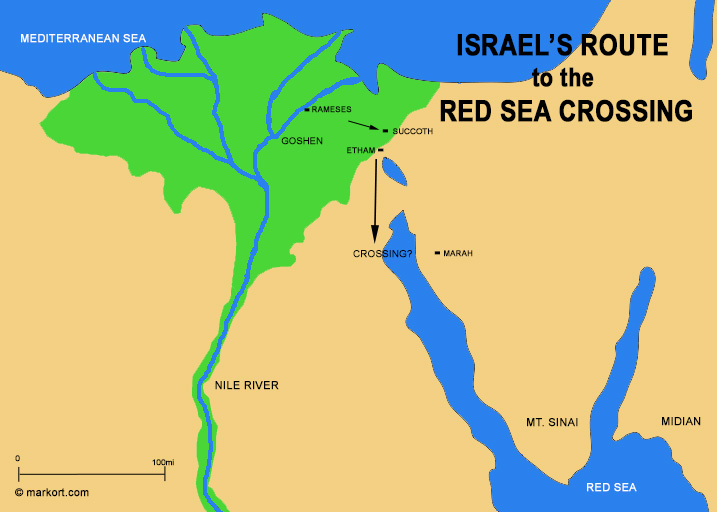
The first stop along the long journey was in a place called Succoth. Interestingly, Succoth is from a Hebrew word meaning, ‘booth’, coming from a root word that means ‘covering’, ‘lair’. It meant a place of protective hiding. Literally, the protection provided by a screen made by weaving branches and thorns together. Same root word is used in Exodus 40:3, the screen that veiled the ark.
Is it accidental or random that the children of Israel would go to Succoth first? God is very intentional with his use of names and places. It’s possible that when the people who were fleeing from Egypt found out they were going to be in Succoth, that they were encouraged knowing that God was placing them in His protective care.
Notice here something about Moses: he recognizes that it was the LORD that brought them out of Egypt, and he’s not afraid to publicly proclaim it. In fact, he mentions it four times in chapter 13 (verses 3, 9, 14 and 16). “For with a powerful hand the LORD” delivered…
Is God still powerful? Is He able to bring us up from whatever it is that holds us captive? Does He have the ability to rescue us from bondage, to heal us, to encourage us, to keep us? Of course He does!
Etham
The next stop was Etham. Possibly comes from the name Khetam or ‘fortress’. It was located on the edge of the Arabian desert and the border of Egypt. Some experts say that Etham was slightly west of modern-day Ismailia which is along the Suez Canal, north of the Great Bitter Lake.
Between The Sea and the Egyptian Army
The sons of Israel are afraid, exclaiming, “Are there no graves in Egypt? Is this why you brought us out to the wilderness to die?”
Moses maintains confident leadership and faith in God’s deliverance, responding that God was going to accomplish great salvation, “stand by and watch”!
In verse 21, Moses did exactly what God told him to do back in verse 16, stretching his staff out over the water. The sea splits and the sons of Israel walked across on dry land, with water on their left and water on their right. The Lord did this!
The Lord put the Egyptian army into confusion. The Lord caused their wheels to swerve. The Lord caused them to drive with difficulty.
It was the Lord that saved Israel from the hand of the Egyptians (v.30). As a result, the people feared the Lord (v.31).
Place yourself in the scene. What are you thinking as you stare at the Red Sea with Egyptian warriors approaching? What goes through your mind as see the waters part? What thoughts rush through your mind as you rush to the other shore? Now, as your heart pounds, what are you thinking as you stand on the other side having watched the sea return to its normal place and dead Egyptian soldiers wash up on the beach nearby?
What the Red Sea Event Teaches Us
Remember
God’s track record is perfect. He hasn’t forgotten His people. We must always bring to remembrance all his amazing deeds. We must always look at God’s character attributes, remembering what sort of God He is. When things look bleak or impossible, God always shows up. In chapter 13, Moses remembers this: “for by a powerful hand, the LORD brought us out of Egypt“. He reminds the people who God is and what He’s done.
The Red Sea crossing doesn’t just make for a nice Sunday School lesson. This is an amazing historic event displaying God’s awesome power. We need to remember this account, especially when things appear to be impossible. God will come through. He will deliver us.
Respond
It’s not enough to simply remember facts about God. Our response to this knowledge is critical!
How did Moses and the Israelites respond? They sang a song of praise! Exodus 15:1-18 contains the lyrics for this song.
How did Joshua respond? At the end of Joshua’ life, he reminds everyone about the Red Sea (and other events) in Joshua 24. He told them ‘you saw with your own eyes’ (Joshua 24:7). As a response to all that the sons of Israel went through, Joshua lays a challenge to them: choose right now who you will serve (Joshua 24:15). Joshua chose the LORD. His response was a commitment to serve this God who had done amazing things for Israel.
Summary: In recalling to mind all that God has done, we will praise Him and we will serve Him!


 Establish my footsteps in Your Word ~ Psalm 119:133