A Lesson on God’s Providence
Exodus 1:1-2:22
What is Providence?
God is continually involved in our lives, directing everything in order to fulfill His purposes. He is actively working in all aspects of His creation and partnering with us personally to accomplish His will. Romans 8:28 says that God ‘causes all things to work together for good to those that love God, to those who are called according to His purpose’. Similarly, in Isaiah, God says, ‘My purpose will be established, and I will accomplish all my good pleasure’ (46:10). Sovereignty says that God has the right and ability to do whatever he wants. Providence says he’s seeing to it that it will happen (superintending).
We are not just bystanders as God goes about His business of orchestrating the events of our lives. We are active participants in what He is doing. In the Romans passage, the ‘God causes’ part carries the idea in the original language that it is a partnership in labor (synergy). We often cannot see what God is doing as life is unfolding in front of us. As we look back over our lives or look at the events of history, we see the hand of God’s providence. Hindsight is 20/20. History teaches us valuable things about who God is, as we will see throughout the life of Moses.
Israel Multiplies
Joseph and his generation had died. And while the children of Israel began to multiply, there was a growing fear that they would outnumber the Egyptians and overpower them (v.6-9). A new king was in power in Egypt; one who did not know Joseph. He put together a plan to appoint taskmasters over them and put them to hard labor. They would be the work force that would build the storage cities of Pithom and Raamses.
The King’s Plan
The people were multiplying too quickly and so the plan of the king was for the midwives to kill any Hebrew baby boy. The threat and inconvenience of too many Israelites was enough of a wicked excuse for the king to snuff out their lives. When this didn’t work, the king commanded his people to throw any surviving sons into the Nile River. These are extreme measures: murdering helpless babies.
God Protects Baby Moses
1). The king’s edict: any baby son born to an Israelite must be killed at birth.
2). The king’s updated edict: surviving babies boys must be thrown into the Nile River.
3). The mother’s hard decision: make a floating basket and put it in the Nile. Moses basket covered with tar (bitumen). Abandoning babies in the bulrushes was a common practice in Moses day! But Amram and Jochabed didn’t ‘abandon’ their son. They knew he’d stay safe in the water with crocodiles and pythons because their God would keep him safe.
4). Daughter of the pharaoh – at the river at the right time and at the right place.
5). Baby Moses used his voice at the right time: Yes babies cry, but instead of being rocked to sleep by the movement of the waters of the Nile, Moses cried at the very moment that the pharaoh’s daughter was nearby.
This Old Testament account of God’s sovereignty over the affairs of mankind, and His providence is a clear message to Christian in at least two areas:
1). We must obey God rather than man. Isn’t this what the midwives did?
2). Parents can be confident to release our children, by faith, into the hands of God, who will see to it that they are cared for. They belong to Him!
By faith, Moses parents (Amram and Jochebed, Exodus 6:20 genealogy), hid him for three months, unafraid of the king’s edicts (Hebrews 11:23). How much faith would be required to put your baby into a wicker basket and float it down the Nile River?! They expected great things from God, just like missionary William Carey who said, “Expect great things from God. Attempt great things for God!”
Moses Escapes to Midian
After growing into an adult, Moses observed how the hard labors were affecting his people. When he finally had enough, he killed one of the Egyptians who was mistreating a Hebrew and he buried him in the sand. When the matter was found out, he became frightened and knew he had to escape since the Pharaoh would kill him for this.
Midian was over 700 miles away. Walking distance is about two weeks, non-stop.
Various classical and historic sources place Midian east of the Gulf of Aqaba, in what is now the northwest part of the Kingdom of Saudi Arabia. These sources include:
▪ 1st century AD—the Jewish historian Josephus
▪ 2nd century AD–the Greek geographer Ptolemy
▪ 3rd century AD—Church historian Origin
▪ 4th century AD—Church historian Eusebius and theologian St. Jerome
▪ Medieval Arab historians/geographers
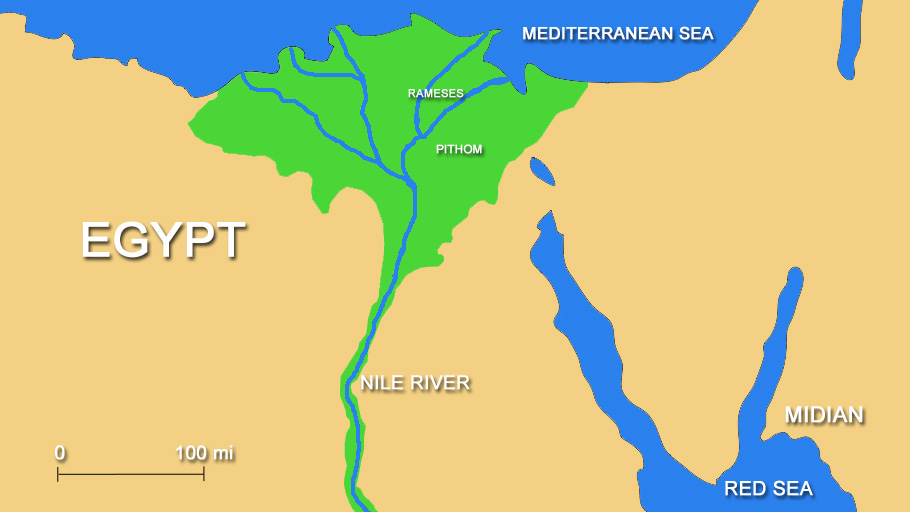
Upon arriving in Midian, he sat down by a well where he then encountered seven daughters of the priest of Midian. Again, this is nothing short of the sovereign hand of God and His involvement in the life of Moses. Is it a coincidence that Moses would ‘just happen’ to sit down at a random well… where his future wife would show up?
These are passages where God is clearly orchestrating events in the life of Moses for a greater purpose. The orchestration shows God’s intimate involvement with people as he accomplishes his good pleasure.




 Establish my footsteps in Your Word ~ Psalm 119:133