Summary Statement
David, the author of Psalm 8, declares that God’s name is majestic in all the earth! God is actively involved in His creation and human beings are living testimonies to His greatness and majesty.
God’s majesty is displayed in His creation and proclaimed through human agents.
Outline

Psalm Superscription
For the choir director; on the Gittith. A Psalm of David.
Gittith – This is a word meaning, “the instrument of Gath”. Gath is the city of Goliath and although the term is not exactly clear, it may be in reference to an instrument either used in Gath, or named after the city. It seems then that this Psalm likely corresponds to the situation surrounding the conflict between David and Goliath. It would be fitting then, and even a bit ironic, that just as David used Goliath’s sword in victory over the enemy(1 Samuel 17:51), that he would use a musical instrument that had ties to Gath to show that God is majestic over ALL the earth… which is the theme of this psalm.
French philosopher Voltaire (1694-1778), in his voluminous writings against Christianity and the Bible, predicted in 1776, “One hundred years from my day, there will not be a Bible on earth except one that is looked upon by an antiquarian curiosity-seeker.” As the story alleges, within fifty years after his death, in an ironic twist of Providence, the very house in which he once lived and wrote was used by the Evangelical Society of Geneva as a storehouse for Bibles and Gospel tracts and the printing presses he used to print his irreverent works was used to print Bibles.
It is plain that this Psalm is David asserting God’s majesty over all the earth. And that includes His sovereign majesty over warrior-giants and Bible-hating philosophers.
We see two ‘lords’ in the first verse: one fully capitalized and the other with only the first letter capitalized. Capital ‘LORD’ is the English word referring to Yahweh (or Jehovah), which in simple terms means “the self-existing One”, and often used in the Old Testament to reference the covenant-keeping God. The other ‘Lord’ is the English word representing Adon (or Adoni), meaning “sovereign master and king”. David strings these names together to paint a full picture of who God is, the ‘self-existing sovereign master and king’.
David describes this ‘self-existing sovereign master and king as ‘majestic’! While it’s impossible to describe God fully by using human words, we understand majestic as being kingly and royal. It is a term pointing to the high and lofty; the great and wide; the noble and splendid.
The Psalmist exclaims ‘how majestic is His name in all the earth’! God’s name is much more than just an identifying mark! His name embodies all that He is. Names are important in the Bible. A person’s name represents a his character, his reputation, his fame. What is he known for? Proverbs 22:1 says that “a good name is to be desired more than great riches”. To the Hebrew, a name embodied their unique character traits.
In the long night of Egyptian exile it would be the fact that they remembered their names – their ancestors, their traditions, their vision of the future – that kept alive their spark of hope for redemption. As long as they remembered their names they were part of the Jewish people and bound to the eternal covenant of being God’s people. In our name lies our soul and self. That is why Jews always placed great emphasis on naming a child, for in that name there lay the history and past of the family and the hopes and blessings for the newborn’s success – Jewish success – in life.1
We have examples of people in the Bible whose names actually changed in order to represent who they were and what they had become. This happened starting very early in the Bible. Abram and Jacob both received different names after having direct experiences with God.
- Abram – exalted father – Genesis 17:5
- Abraham – father of a multitude
- Jacob – heel-holder; supplanter (layer of snares) – Genesis 32:28
- Israel – he who strives with God
In the New Testament we have a man named Saul, who persecuted Christians, but then after he had an encounter with the risen Jesus Christ, his name was changed to Paul.
Saul – desired (of Hebrew origin); Paul – little or small (of Latin origin)
These couple of examples show how names are much more than just a personal identity marker. Names mean something very important to God. As such, He takes His own name very seriously. It’s why He says in the third commandment, “do not take the Name of the Lord in vain” (Exodus 20:7). Taking the name of the Lord in vain is more than just using it as part of a curse word. When a believer misrepresents God in any way, they are bringing reproach upon the name of the God they claim to belong to. This is taking His name in vain. This ought to make us sober-minded, realizing that our testimony is vastly important!
A few example passages from Exodus and Deuteronomy open a window for us into God’s name:
– Exodus 3:14-15 – I am who I am, this is my name for ever, my memorial name; The One who causes to be – I am the cause of all things. I am self-existent and eternal. I am source and sustainer.
– Exodus 33:19 – I will proclaim my name. A name is much more than an identifying label. It is the nature and character of the person or being.
– Exodus 34:5-7 – God proclaiming His NAME. Declaring his character, his personality, his very identity.
– Deuteronomy 12:5,11 – Establish his NAME – his reputation, his memory, his fame
– Deuteronomy 32:3 – Dying Moses proclaims the NAME of the Lord, ascribing greatness to Him and describing what sort of God He is!!
Based on the dominant theme of creation in the whole chapter, verse 2 could have a strong connection to the fact that every mother in those first generations likely hoped that their child was the promised one who would overcome the evil one. David could very well be saying that even infants and nursing babies know that the name of the Lord is majestic; it’s obvious to even the young and dependent children. But it seems more likely that David is indicating that a long line of succession of children after Adam and Eve offered hope that the strong Messiah was on His way to ‘make the enemy and revengeful cease’.
Verse 2 is a reflection from David, giving thought to the heavens above him. It is a simple thing to the Creator of the universe to decorate the skies with stars and the moon. In an anthropomorphic description, he basically says that God put them there with a snap of His fingers. We know that God doesn’t have literal fingers and we also know that He ‘spoke’ everything into existence (Hebrews 11:3). But David, in his poetic form of communicating the truth about this majestic God, shows us how easy it is to put celestial beings into place.
Verses 3-8 continue with heavy overtones of Creation, emphasizing God’s concern for mankind. The phrases seem to bounce back and forth between a reference to mankind in general and a corresponding reference to the coming Savior. We could separate theses phrases as follows: we will notice that the phrase on the left from each verse is pointing to humankind like ourselves, while the phrase on the right has strong leanings toward Jesus Christ, as I will point out below.
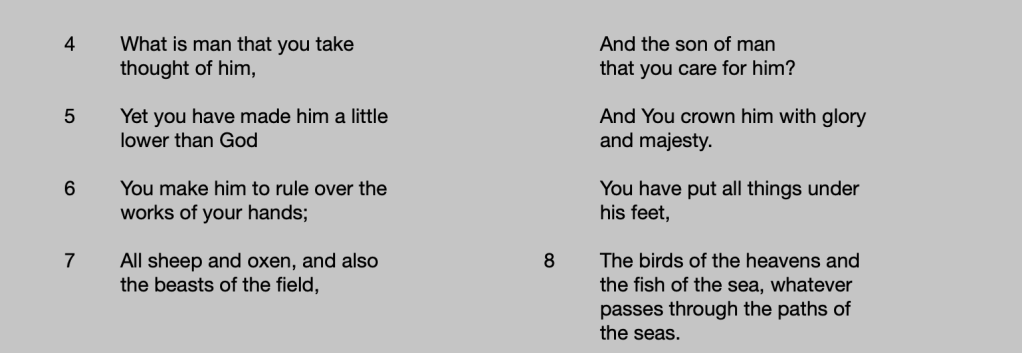
We note the following in these verses:
- There are two Hebrew usages of the word “man” in verse 4. On the human side of chart, man is the word ‘enosh’. Back in Genesis 4:26, we are introduced to a man named Enosh. He was the son of Seth, who was named Seth by Eve because she was already looking for the promised Savior (Gen 3:15) and may have wondered if it might be him. The name Seth means, “the appointed one, the substitute”. The other use of “man” in this verse is the word, “adam”. The genealogy in Luke 3 very clearly shows that Jesus, through all the generations listed, is the Son of Adam.
- Also in verse 4, there is the concept of “take thought of” and “care”. When taken together, this means a divine intervention that changes the destiny of people. It is the concept of visitation which is used in multiple places in the scriptures. Here are a couple times where God visited someone (or intervened) in such a way that their entire lives became different:
– Genesis 21:1-3 – God visited Sarah – and she conceived a child with Abraham.
– Exodus 4:31 – God visited the children of Israel – saw their affliction and delivered them in a dramatic way.
This points us to the intervention that happens when Jesus Christ steps in and delivers people from their sin, providing forgiveness, cleansing and a guaranteed eternal home in heaven! - A little lower than God, mentioned in verse 5 points to us being made in God’s image (Gen 1:26-27), but then speaks in the next phrase of Someone being crowned with glory and majesty, namely the Messiah, Jesus Christ!
- Verse 6 reminds the reader that humans have been given dominion over the earth (Gen 1:26), however the only One who would have ALL things under his feet would be the one who is sovereign over all, and that is the Lord Jesus.
- Continuing on with the dominion theme, we recognize that the sheep, oxen and other beasts of the field are generally the kinds of animals that people utilize in farming. They are in barns or enclosed behind fences and used in the agricultural settings. Then in verse 8 we have birds and fish that are in much more wide open spaces that we have not much control over as humans. While we have some use of birds and fish as humans, the majority of them are way out of our reach… most birds will fly free their whole lives and most sea creatures are in the depths of the ocean in places that only God can know.
This beautiful chapter ends right where it began: how majestic is God’s name! Repetition in the Psalms is common because it provides emphasis in our learning process. The declaration of the majesty of God’s name gives us understanding of who He is and our response must include proper praise and adoration!



 Establish my footsteps in Your Word ~ Psalm 119:133