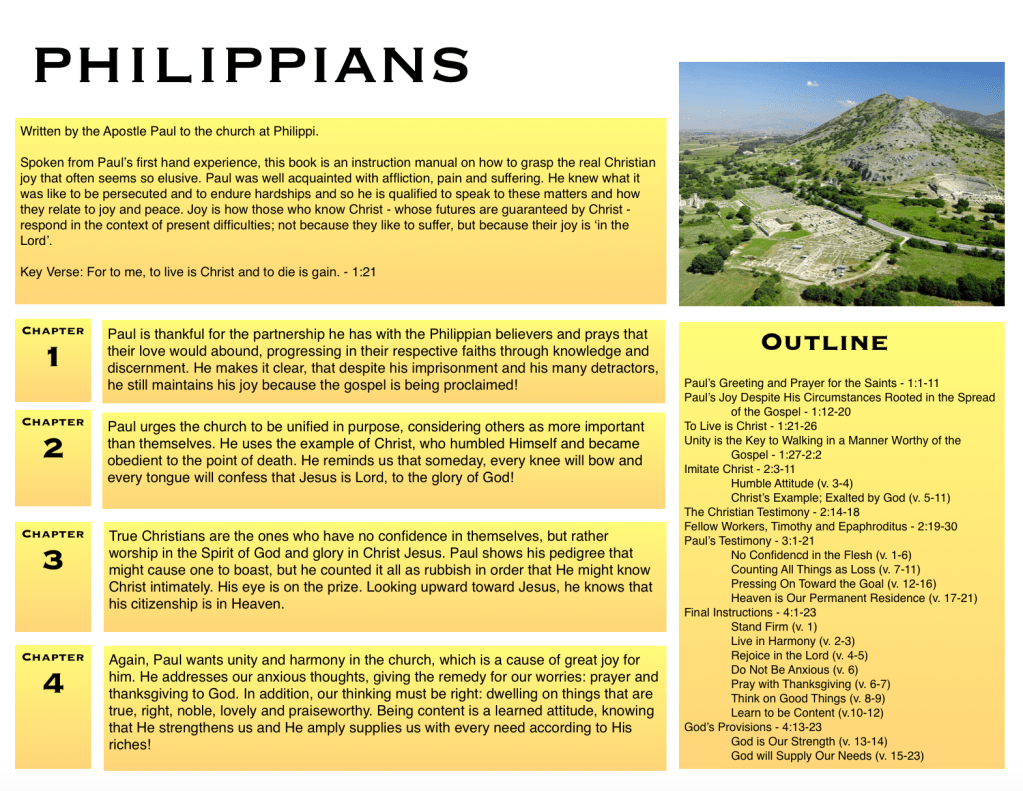
Introduction
The uncertain times in which we live cause us to turn to God in desperation more than ever before. What we need is joy and peace, and the Lord has given us all things pertaining to life and godliness in the Scriptures. When the days are dark, we know that God’s Word is a lamp unto our feet and a light unto our path (Psalm 119:105).
Paul’s letter to the Philippian believers is an instruction manual, spoken out of first hand experience, on how to grasp the real Christian joy that often seems so elusive to us. These words from the Holy Spirit spoken through the Apostle also teach us how to enjoy the peace that we’ve strived after for so long. Paul greatly encourages us because he lives this life of joy and peace in spite of all the circumstances that could otherwise bring him to despair.
We don’t have to despair over our circumstances either. This life of joy and peace IS obtainable through serious meditation on the passages in the book of Philippians.
Philippians 1
I Thank My God
Philippians 1:2-5
The Apostle Paul had an affinity for the people at Philippi. One of the reasons he wrote to them was to thank them for their unwavering support. He loved them because he had invested himself in them. And they had invested themselves unselfishly in his ministry. He issues one of the highest forms of greetings to them by wishing them grace and peace.
Grace to you and peace from God our Father and the Lord Jesus Christ. I thank my God in all my remembrance of you, always offering prayer with joy in my every prayer for you all, in view of your participation in the gospel from the first day until now. Philippians 1:2-5
The fact that the Christians at Philippi supported Paul in his mission work is a testimony that they were involved deeply in what God was doing through him. They were glad participants in the spreading of the glorious gospel of Jesus Christ from day one! This had to be a great encouragement to Paul. As he sat in prison under house arrest, he recalls their faithfulness and writes them this amazing letter of joy. Imagine the overwhelming joy of the people reading the letter, knowing that the gospel is being proclaimed despite Paul’s circumstance.
Paul mentions that he joyfully thanks God for them in his every prayer! Prayers of thankfulness produce joy! It is a great sin to take for granted the people that God has put into our lives. We likely have a long list of people who have influenced us, helped us and encouraged us. Every time we pray, it would be right to joyfully thank God for them!
Faithful to Complete the Work
Philippians 1:6
God doesn’t do anything half way. He finishes what He begins. The process may not be the same as what we may have in mind. He may go more quickly or more slowly than we have hoped. He may send us down a different path than we thought we’d travel. But He knows what He’s doing.
For I am confident of this very thing, that He who began a good work in you will perfect it until the day of Christ Jesus. Philippians 1:6
The older I get, and the more time I spend in self-evaluation, I realize how flawed I am. I recognize that I have some serious imperfections. I know that I cannot progress in my Christian faith without God and His Spirit leading me every step of the way. I fail often. I make mistakes. I disappoint my family and friends. I displease my Father. Not that I want to, but because I am still in this fleshly existence, I fight against righteousness. I gravitate towards the world. The allure is exceedingly strong and when I succumb to it’s attraction, I feel like a failure. I hurt my Lord by finding pleasure in something other than Him.
But God is not done with me yet. This verse in Philippians guarantees that God is not going to leave me on my own to finish the work He began. HE is going to do it. What He started, He will finish. I won’t always give into temptation. I won’t always have to fail. This verse gives me the greatest hope.
Real Knowledge and All Discernment
Philippians 1:9-10
Paul makes this prayer to God on behalf of the Christians at Philippi: that their love would abound still more and more. Not that these weren’t loving people, because they were – but the love that they possessed and exhibited would overflow. Love is not biblical love unless it is rooted in the truth of the scriptures. Love must be accompanied by ‘real knowledge’ and ‘all discernment’. That means that we must have mature understanding and insight regarding God’s Word. It is much more than a wooden adherence to the Law out of sheer duty. Although strict obedience to God’s commands is necessary, there is the important element of genuine heart-felt love for the things of the Lord. It is a complete, whole-hearted, sincere devotion to God and the Holy Scriptures. It is an insatiable desire to quench our thirst with the water of the Word, and we don’t stop until we are filled.
And this I pray, that your love may abound still more and more in real knowledge and all discernment, so that you may approve the things that are excellent, in order to be sincere and blameless until the day of Christ. Philippians 1:9-10
By praying for discernment, Paul recognized that even Christians can make bad choices because we’re not thinking clearly. Sometimes we don’t know all the facts, sometimes we’re in a hurry, sometimes we want things our way. And so we make a regretful decision on something. But Paul is praying for discernment, the ability to distinguish right from wrong. That is, he’s praying that we would be aware of the things that cloud our minds or blind us to reality. Yes, there are things that will darken our spiritual eyes so that we do not see what God is trying to tell us through His Spirit. We need to rid ourselves of these things, which could be things like TV, music, impure thoughts (anything that distracts us from God’s way). If we put ourselves in a position that is far away from the distractions and put ourselves in a place where we are receptive to the things of God, then we will likely receive more light from the Holy Spirit and He will help us to develop skills in discernment.
Not only will we start to grow the fruit of abounding love, but now we will be able to ‘approve the things that are excellent’. This is the development of the skills of determining what is vital; deciding between good, better and best; what’s necessary and what’s unnecessary; separating the important from the unimportant. If we can develop these important skills, we are well on the path to being productive for the kingdom. But it takes a concentrated effort to protect our time well and use it for intense study, critical thinking and, of course, meaningful and fervent prayer for understanding.
We should study the Bible as dry and thirsty people. The result brings forth much fruit – the fruit of abounding love.
Progress of the Gospel
Philppians 1:12
The Apostle Paul didn’t let his circumstances deter him from proclaiming the gospel. In fact, he says that his circumstances has actually resulted in the greater progress of the gospel. As a prisoner, chained to a Roman soldier, Paul was in a bad situation. To add insult to injury, many of his contemporary pastors were actually causing him distress because of their self-seeking motives (1:15-18).
Now I want you to know, brethern, that my circumstances have turned out for the greater progress of the gospel. Philppians 1:12
He uses the word gospel nine times in his letter to the church at Philippi, five times in the introductory chapter alone. In its general sense, the word ‘gospel’ means ‘glad tidings’. But as we study this word in scriptural context, we discover what a most beautiful word it really is. The glad tidings that the Bible speaks of is the amazing news of what has been done on our behalf to fix our fractured relationship with our Creator, restoring us back to a right relationship to Him.
We are part of a broken world. We’re broken ourselves. Our sin has distanced us from God and as a result we’ve chosen a path that leads to destruction (Romans 3:23). Indeed, we are literally on the Highway to Hell as those seventies Rock and Roll philosophers once sang about. But far from the party that many people think is happening in hell, it is a place of outer darkness, pain and lonely suffering without end (Matthew 13:42, John 3:36).
Our personal sin must be dealt with. It is something needs to be paid for. Since sin is infinitely offensive to a holy God, we must pay for it with infinite consequence in that real place called hell, where real people go to suffer an eternal conscious punishment. It is what a just Judge does: serving up justice when a crime is committed.
But that beautiful word ‘gospel’ comes into view here: Jesus came to be our acceptable substitute. The wrath of God was poured out on Him. On that Good Friday all those years ago, God laid upon His One and only Son the sins of the whole world, so that those who would believe in Him might be saved from this sure destruction in hell. This is not just good news. This is the most awesome news that mankind has ever been told! When we put our hope and trust in the finished work that Jesus did on the cross on our behalf, we are saved from the wrath that belonged to us. And not only that, God credits Christ’s righteousness to our account so that we become as pure and spotless and blameless as Christ Himself (an astounding assertion from Romans 4:5 and 2 Corinthians 5:21!). This is the only way to escape hell and gain heaven (Acts 4:12). Faith alone in Christ alone ensures us a place in heaven forever… and that never came from anything good in ourselves, it is purely a gift from God to those who accept (Ephesians 2:8-9).
This is what brought joy to Paul and what will bring joy to us.
Proclaim the gospel no matter what the situation or circumstance. Watch God work through your words and example.
To Live is Christ
Philippians 1:21
The most succinct description of what it means to be a Christian has been written in God’s Word in Philippians 1:21.
For to me, to live is Christ and to die is gain.
To live is Christ: What does this even mean? To live AS Christ would be loving as Christ loved, forgiving as Christ forgave, sacrificing as Christ sacrificed (laying His life down for those He loved). This is to live AS Christ. But Paul writes ‘to live IS Christ’.
The answer is found right in the text: ‘if I am to live on in the flesh, this will mean fruitful labor for me’ (v.22). Paul says that ‘living’ will mean laboring for the cause of Christ. Everything about his life will be for the sake of Christ. Gordon D. Fee says in his commentary, Paul’s Letter to the Philippians, that Christ is the name that: ‘sums up for Paul the whole range of his new relationship to God: personal devotion, commitment, service, the gospel, ministry, communion, inspiration, everything’.
Worthy Conduct
Philippians 1:27
The phase in this passage ‘conduct yourself’ in a general sense means to do everything in your power to be a good citizen. It’s root word comes from the word that we get ‘politics’. Paul’s readers would get what he’s saying: do individually what is necessary for the good of the whole. Blue Letter Bible defines the phrase as this: ‘to conduct oneself as pledged to some law of life’.
Paul defines what Christian conduct entails right in this passage. Biblically, one aspect of being part of the Christian community of believers is to walk in unity with one another. We don’t live on an island where we play by our own rules. We live in relationships with one another, and Paul is calling Christians to be unified. Believers often have some of the most complex personal interactions with each other. Sometimes we shoot our own wounded. We stab one another in the back. We’re often our own worst enemies. Why is this happening?
This should not be a surprising concept: conduct worthy of the gospel, according to Paul in this passage, is that we must be ‘standing firm in one spirit’. Instead of strife and discord with one another, Paul shows us a different way: one mind, striving together. Not that we walk lock step with one another, because we’re all unique and are at different stages of growth. Paul is talking about going after the same goal, working together, unified around the truth. Christ and the glorious gospel are the goal, and the truth of the Scriptures are the means by which we achieve the goal. There is a unity of spirit as a result of rallying around the truth.
Philippians 2
The One Thing
Philippians 2:1-4
Paul implores his readers in this passage to strive after one fundamental thing. He wants them on the same page, being unified in this one purpose: being Christlike. Being like Christ has many aspects to it. It certainly includes the things I do (my behavior), but it’s also who I am as a person (my thinking). Paul begins this chapter with an attitude check that should result in how we act toward others.
Do nothing from selfishness or empty conceit, but with humility of mind regard one another as more important than yourselves; do not merely look out for your own personal interests, but also for the interests of others.
Selfishness
The sense of this word describes someone who is in pursuit of a political office, who goes after that position by means of unfairness and trickery. It is someone who misrepresents who they are, putting themselves forward by any means that may bring about their own success. As is the case for any selfish person, they are always putting themselves first at the expense of anyone in their path. Self-promotion, self-preservation, self-congratulation, all characterize this individual.
Empty Conceit
The King James Bible uses the term ‘vainglory’, which is the old school way of saying ‘vanity’. The Webster’s 1828 dictionary defines it as ‘exclusive vanity excited by one’s own performances’. It is selfishness taken to the next level. Empty conceit is groundless self-esteem, rooted in pride. It is selfish ambition and self exaltation. A person driven by these types of motives is one who is not seeking after the glory of God, but rather their own glory. The phrase in the second half of Proverbs 25:27 says that it is not glory for a man to seek his own glory.
Putting selfishness and empty conceit under the microscope of examination reveals what loathsome character qualities they are. They are the equivalent of contending against God. It is God alone who deserves the attention and praise of men, but we’re guilty of seeking that glory for ourselves. Paul says to stop! Do nothing from selfishness or empty conceit.
Instead, we are to genuinely think of others as being more important than ourselves, looking to their interests much more than than our own. Viewing others in this way requires humility because we can no longer consider ourselves as being ‘number one’. Our former inclination to self-exaltation is replaced with a strong desire to promote the welfare of those around us because, in our new way of thinking, their concerns are more important than ours. Humility is not something that we muster up on our own, but the mind that is receptive to the enabling work of the Holy Spirit will see others in this way.
Becoming more like Christ requires the elimination of selfishness. It demands that we put empty conceit to death. It requires our personal interests be put aside. And it requires the interest of others to be paramount.
Philippians 3
Philippians 4





 Establish my footsteps in Your Word ~ Psalm 119:133