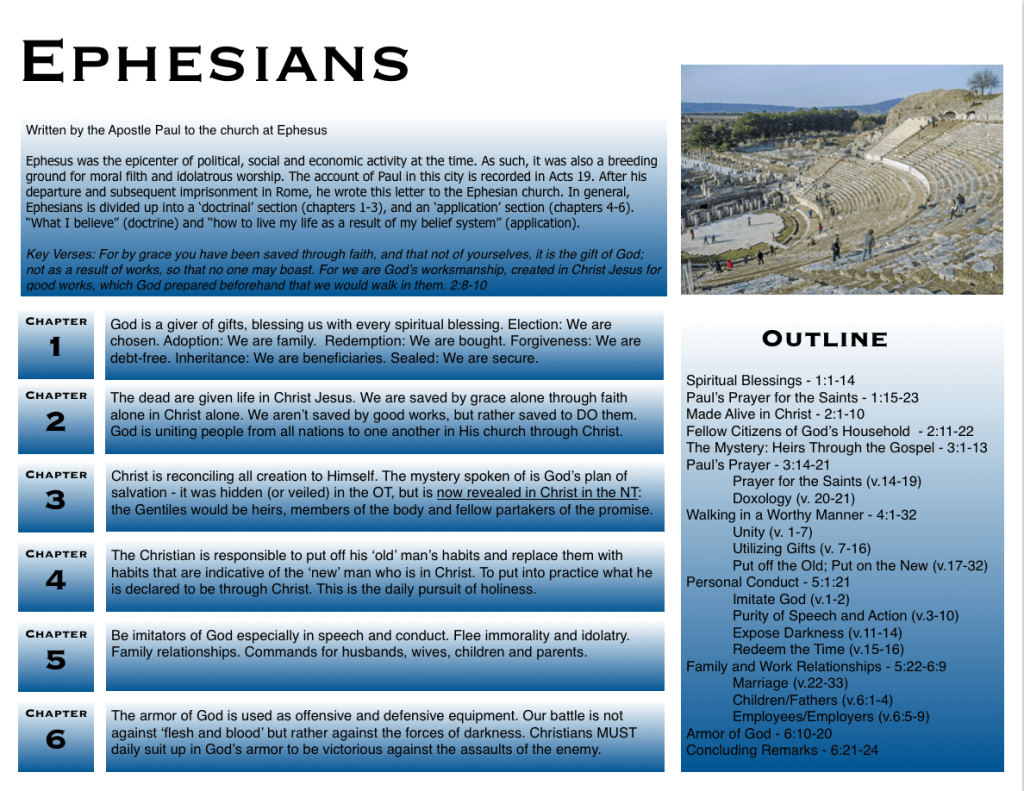
Chapter 1
Chapter 2
Chapter 3
Chapter 4
Chapter 5
Chapter 6
Background
The city of Ephesus, in the days of the Apostle Paul, was a thriving metropolis and the epicenter of economic, political and social activity. The fact that it was on a travel route made it a merchants dream come true. But Ephesus also had a dark and sinful side, as do all cultures that trade the true and living God for false gods conceived in the minds and made with the hands of men. Ephesus was a breeding ground for moral filth (every kind of impurity, Eph. 4:19) and idolatrous worship.
The remains of Ephesus can still be seen and visited today. There was a ‘main street’ where vendors would sell things in an open air market. As one would walk from the harbor through the marketplace, they would see bath houses on the left. Beyond the bath houses was a gymnasium complex that was not only used for sporting events, but academic instruction as well. On the right of the street was a library. There were fountains and gates and walls and plazas. The place was full of activity. On back streets a person could find brothels where some of the sexual debauchery took place. Scattered throughout the metropolis were various temples, built to honor false gods. The most famous was the Temple of Artemis (or temple of Diana) that was about a mile from the main part of Ephesus. This was a place of pagan worship where the goddess Diana was served by prophetesses who were really the temple prostitutes. This temple was also a large financial institution – really the Bank of Asia – a place where all sorts of financial corruption took place. At the end of the main drag was a large theater with a capacity of 25,000 people, the largest open-air theater of it’s kind.
It was in this city that Paul spent several years building the church. There were Christians in Ephesus. Archaeology also has uncovered signs of Christians in the city. In outlying residential areas, archaeologists have found homes with stone porches with fish carved in the steps. We put the fish symbol on our cars, but back then, it was a secret indication to other Christians that a follower of Christ lived here or conducted business here. Paul was very familiar with the activities at the Temple of Artemis and had at least one run-in with a large and angry crowd at the theater. We read about the Christians and the immoral and idolatrous culture that they had to endure in the book of Acts.
Paul in Ephesus
Paul, in his usual way, was bold in sharing Christ in Ephesus. He would preach in the synagogue and perform extraordinary miracles. People were getting saved and the Word of God was prevailing and growing mightily (Acts 19:20).
Demetrius, a silversmith who built silver statues of Artemis gathered all his workmen together and stirred them up saying that Paul was going to put them out of business if he kept witnessing.
A riot ensued and people from the city filled the theater chanting ‘Great is Artemis of the Ephesians’ for 2 hours. They dragged Gauis and Aristarchus, Paul’s traveling companions, into the theater. Paul wanted to go into the theater, probably to preach to this huge audience, but the other believers convinced him not to go.

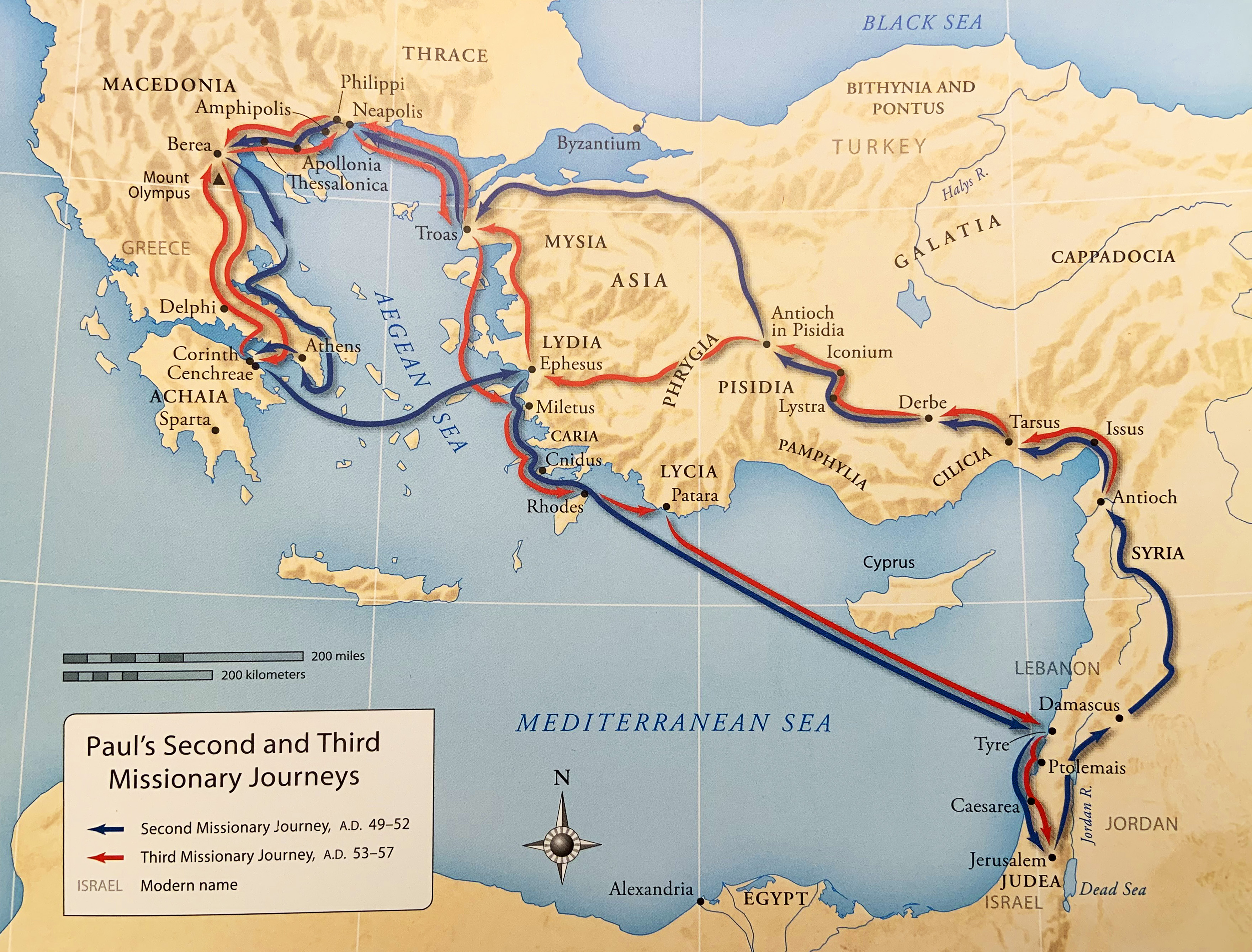
Shortly afterwards, Paul sailed out to Miletus, about 40 miles away and called the elders of the church of Ephesus to him so he could give them a farewell charge.
Paul in His Farewell Address
After Paul’s departure from Ephesus, he knew that this group of Christians were going to face some serious threats to their faith in light of the corruption, immorality and idolatry. So in Acts 20, Paul address the elders of the church and gives them a few words of much-needed encouragement:
1). Be on guard for yourselves and for the flock, lest savage wolves come in to destroy them.
2). He commends to them God, and His Word, which is able to build them up. In other words, ‘stay committed to God and His Word’.
Discussion Questions
When Paul came to Ephesus, he found some disciples (Acts 19:1-7). Describe that conversation.
Paul preached in the synagogue at Ephesus. What were his sermon topics and what was the reaction of the listeners?
Who was Artemis? What causes people to pursue after false gods?
What motivated Paul to risk his life by confronting the silversmiths?
When the angry mob dragged Gaius and Aristarchus into the theater, Paul wanted to go with them in an apparent attempt to address the crowd. What do you think his message would have been and do you think he was wise in wanting to do that? And why do you supposed God didn’t allow that to happen?



 Establish my footsteps in Your Word ~ Psalm 119:133