“It’s too late. Your church is going to die”, I told the elderly man. “You should have been asking these questions twenty-five years ago”.
As a person in my sixties, I was among the youngest of the worshipers that day, visiting a church with my friends for the second time. The congregation was friendly. They seemed to love the Lord. But every single one of them were elderly. “How can we get younger people into our church?”, the man asked me. Over the years, the old people got older and the young people fled. Nobody ever asked why.
I know that the Lord continues to build His church and the gates of hell will not prevail against it, but this particular church is dying. And it’s not the only one like it. Since that time I attended two others that were in the same exact condition. The people lamented to me (assuming) that the younger generations are “flocking to the big churches since they have more to offer”.
At least two other conversations with an entirely different set of people went something like this: “why don’t we have many young people in our church?”, and “the ones that do come never get involved in anything”.
What’s Going on With Our Kids?
At first I tried to gather some information about Millennials and Gen-Z online. What I found initially seemed inconsistent and puzzling, but some trends started to emerge. In an attempt to further understand the thought process of the younger generation, I drafted a five-question survey and sent it to some members of this age group. The sampling size is small (around 20 participants), but in comparing their more personal answers to larger national online surveys, the responses I received contained similar threads. I was able to piece together an overall perspective which may help in addressing their absence in some of our churches.
To be sure, the way we do church changed dramatically during the Covid era. And there is absolutely no question that Gen-Z is having a spiritual awakening. Have the older generations even noticed? The Covid lock downs exposed an epidemic of loneliness and catapulted masses of young people into a search for the meaning of their existence. They are in a pursuit of something higher and more transcendent than themselves. Have we noticed? Do we care? Will we do anything to help them?
According to some in-person conversations I’ve had with a handful of the respondents, the answer to these questions is regrettably, ‘no’. Many believe they’ve been left out in the cold to fend for themselves to blaze a spiritual trail on their own. A few of them are convinced that the ‘do-it-the-way-we-always-have-done-it’ church leadership is asleep at the wheel. One of the participants lamented that they’ve inherited a ‘schizophrenic church’ from the Boomers.
What does all of this mean? Ignoring these kinds of expressions from our children is not an option. This informal survey was intended to initiate conversation across the generations. As the responses came in and the conversation grew, it became necessary to summarize and categorize what they have said from their hearts. What cannot be shown or communicated in written form is the body language, tone of voice and emotions from the in-person conversations, all of which were very important in interpreting their feelings and positions on the church.
However we interpret the results of this survey, I am in no way suggesting that the modern church move away from the Biblical mandates of how worship should be conducted. I hold firmly to the Biblical principles that govern corporate worship. What I am suggesting is this: it is critical for the modern church to conduct corporate worship biblically, while understanding and meeting the spiritual needs of the young people. They are worshipers too. Our church is their church and they are important to the health of the body. If we want the body to die, ignoring certain parts of it will ensure its eventual death. The neglect of the spiritual development of the Gen-Z demographic will result in the mass exodus from our churches and our buildings someday being sold to restaurateurs to sell wings and craft beer.
Demographics of the Survey
- Intended Audience
- Active church attenders
- Different churches
- Age 20-30 (Gen-Z was the target audience)
- Equal number of male and female
- Actual Audience
- Two self-proclaimed ‘seekers’
- Remaining were professing Christians
- Different churches from at least 3 different states
- No one from my own church was a participant
- Age 20-43 (my references to Gen-Z below includes the Millennials included here)
- Equal number of male and female
The Five Questions From the Survey
1). Name two things that you feel that the modern American church does well and benefits your personal growth.
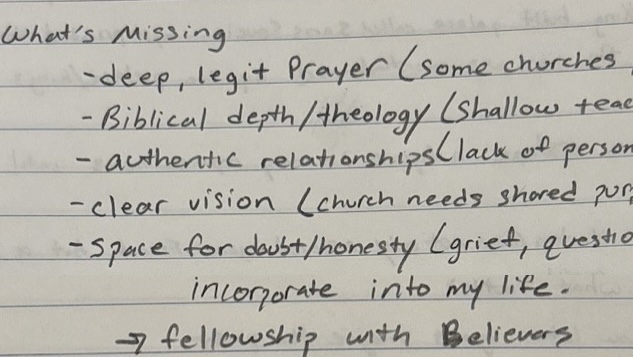
2). What things are missing that you think are necessary elements of a well-functioning church?
3). What things is the church doing currently that are irrelevant and would you eliminate?
4). The most exciting thing about church is _________.
5). The biggest turn off at church is ____________.
Most of the questionnaires were sent out via text or email and answered in kind. There were also several in-depth face-to-face interview style conversations and one phone call. Those discussion points are paraphrased and included in this summary.
I will take each question in order. Although each section will take on its own format, each part will include some or all of the following:
- Actual quotes from the respondents
- A summary statement from all the input on each question
- Commentary where I felt it was appropriate, along with supporting Bible verses or other important sources
- A call to action or even mild rebuke to the older generation where it seemed necessary
My goal was to let the survey participants speak for themselves. The nature of this research, however, requires some interaction on my part. First, to summarize it in an organized fashion and secondly to draw out some conclusions that provoke us to action. I tried to limit my own biases and my own observations, but in some cases those will be obvious. These interjections are colored by my interpretation of the written comments from the survey takers and the additional conversations/follow-up with the targeted age group. You may notice some seemingly contradictory statements. For example, one person appreciates the casual dress code at church, while another prefers more formal attire. My commentary is based on the feel of the majority of the participants.
This was an eye-opening project to say the least. I came away with some regret for the condition in which my generation has left the church. But I also came away with bold hope for the future of our churches because of what God is doing in the hearts and lives of our children and their children.
Question 1
1). Name two things that you feel that the modern American church does well and benefits your personal growth.
“The modern church is more come as you are which I feel puts more emphasis on God than appearances.”
“Churches are now live-streaming and spreading God’s word more than ever before.”
“Incorporating strong worship songs and providing many opportunities to serve.”
“The modern church across the board feels very welcoming. I have been accepted with open arms at Catholic, Protestant, non-denominations and Orthodox churches.”
“Guides individuals to identify and put their spiritual gifts to work and serve within the church or community.”
The survey respondents indicated that the modern church has many opportunities to assist them in their growth, such as small group gatherings, community service and short term missions trips.
They also indicated that the church emphasized a healthy balance in stewardship of their spiritual gifts and finances.
Many feel like they are warmly welcomed at church. Visitors do not want to be a part of the ‘frozen chosen’ and will quickly find a more friendly church if they feel like they’re intruding.
Question 2
2). What things are missing that you think are necessary elements of a well-functioning church?
“Clear accountability, effective discipleship — not casual hangouts or talking through a chapter but doing life together.”
“Come as you are has its biblical rationale, but I think the church would benefit from a little more structure and reverence (traditions, communal fasting, prayer/liturgies during services).”
“Deep legitimate prayer”.
“Church needs shared purpose and direction”.
“I think there could be more deep and honest discussions.”
Common themes appeared in the survey responses for a well-functioning church, including the necessity for clear vision in the church leadership, the need for meaningful corporate prayer, clarity of truth and theological depth in the sermons and Bible studies.
Clear Vision and Planning
More structure and organization is desired by the younger generation. They see our lack of planning. They notice unprepared pastors. They do not appreciate the ‘winging it’ approach to church. They are the future of the church but don’t see themselves as a part of it because current leaders do not have a clear vision of what their local church should look like in twenty or thirty years. If they do, they aren’t taking the steps to get there. Not having a long term plan is not a good plan.
Corporate Prayer
Churches that do not pray together regularly will eventually fail. One of the defining marks of a body of believers is striving together in corporate prayer. All age groups must be gathering to pray for one another. By not doing so, we violate God’s warning of, “not forsaking the assembling of yourselves together, as is the habit of some, but encouraging one another; and all the more as you see the day drawing near”.1 Nobody understands the need for encouragement more than the generation that got locked away during Covid. Nobody understands this more than the ones who have a high rate of loneliness and depression. There are many good reasons why praying real prayers together was a very prominent theme in the survey responses.
Clarity of Truth and Theological Depth
This is the desperate cry of most people who are truly seeking God: they do not want to be ruled in their hearts by uncertainty but rather they hunger for a settled conviction with regard to the truth. This means no uncertainties, no doubts and no lack of clarity!2 The job of every pastor, every elder, every Bible teacher and yes, every Christian, is to clarify the truth of God’s Word. Every young person I’ve spoken to on this topic demand clarity.
Young people are not looking for a pep rally or life coach type of sermon. They want their pastors and teachers to instruct them methodically through the Bible. They want to know what it says, what it means and what they are supposed to do with it (real-life application of revealed truth is vitally important to this age group)! They are intelligent and desire meaty doctrine when they are ready for it. They cannot endure shallow teaching for long and wallowing in it is unacceptable as they mature. They also recognize the need for balance.
This requires that the shepherds know their flock. The wrong food or not enough food will result in unhealthy or starving sheep. Conversely, too much food all at once will cause the sheep to choke. “Information dumping” and “firehose approach” were terms used in the survey responses to describe feelings of being overwhelmed in some learning contexts, while “shallow” and “no scripture” characterized some sermons on the opposite side of that.
Our survey-takers expect their pastors and Bible teachers to know how much they can digest and at what rate. These are communication art forms that are difficult to learn and practice, but not impossible if teacher and student talk with each other. Pastor John MacArthur’s staff at Grace Community Church always had debriefings after every sermon, discussing what kind of things could be improved upon since the goal is to make the Bible crystal clear. Pastors need to have regular feedback, especially from this demographic, to make sure they are connecting.
Other topics from this question included reverence for God, personal accountability, authentic relationships and effective discipleship.
Reverence for God
This is a complex concept, but two aspects stood out in some of the survey responses: attire and facility. They ask why people who are approaching the God of the universe in holy worship would not dress themselves to fit the seriousness of the occasion. They also ask why some of our churches look more like a pole building than a structure set apart to honor the living God.
Skinny jeans and T-shirts have replaced coats and ties. The hip warehouse vibe has replaced the grandeur of cut stone, wooden pews and stained glass. Shallow song lyrics have replaced the theological rich hymns of old. Most of this is not necessarily wrong. We know that God looks upon the heart rather than on the outside of the person; we also know that He doesn’t dwell in a place made with human hands and we also are aware that it’s OK to sing a new song unto the Lord.3
But these are very legitimate concerns for a generation that seeks a restoration of the reverence for God and the longs for the return of beauty in worship. Is not our God a God of beauty? They seem to agree with pastor and writer Philip Ryken who observes, “If our God is such a beautiful God, then we, of all people, ought to have the highest appreciation for beauty. When Christians settle for low aesthetic standards, we compromise the character of our God.”4
In general, the respondents are not impressed with our casual approach to God. They are asking a question that many ‘seasoned’ Christians refuse to ask, “Is corporate worship something that is set apart and completely different than anything else we do?” What are we communicating to them by how we dress and what our place of worship looks like? Is attending a holy worship service the same as going to a concert or a high school basketball game? Are we, as the older generation, doing anything to preserve the solemnity and sacredness of the worship experience?
Our children want to know, because they are seeking to offer worship in a place that is fitting to the majesty of the One they would worship. They understand the concept of holy ground, and that’s the place they want to be.
Effective Discipleship/Mentorship
One person in the survey had this to say, regrettably: “There is hardly anyone in the church worth emulating. They are all mostly self-absorbed“. I have found from personal experience that true discipleship is a lost discipline in the church. It is rooted in two sad realities: 1). Many people are either too busy to invest in the lives of others or they just simply are not interested, and 2). Church leadership either does not know how to implement discipleship programs or they just simply are not interested. And yet right before our eyes we have a whole generation of young people who crave to have mentors in their lives, people who will model Christ to them and instruct them in wise behavior. To our shame, we are not fulfilling the Great Commission where Jesus Himself says to “go therefore and make disciples… teaching them to observe all that I have commanded you”.5
Personal Accountability
Flowing from the point on effective discipleship, the Gen-Z population wants to be held accountable by older and more mature believers. They crave for someone in their lives who has ‘been there, done that’ — someone who will walk with them in their questionings, struggles, doubts and griefs —someone who will give them honest and constructive advice — someone who will lovingly call them on the carpet when necessary.
Authentic Interactions
The survey revealed one thing that Boomer worshipers are really good at: inauthenticity. We love fake things. We decorate our churches with fake flowers. We love to eat stale cardboard-like squares purported to be communion bread at the Lord’s table. We greet each other on Sunday morning with the “everything’s fine” smile. These kinds of things, as silly as each one may sound, scream ‘inauthentic’. The Gen-Z’ers in our lives hate ‘fake’. They hate fake flowers, fake bread, fake smiles and anything else fake… especially fake relationships. What-you-see-is-what-you-get-authenticity is what they’re after.
Gen-Z wants to dive beneath surface talk. They desire honest conversation. They don’t have time for meaningless small talk. We should know these things about them, but we don’t. So it’s time to engage with them at a much deeper level and establish real relationships with them.
God-Honoring Worship Music
For the survey respondents, there appeared to be a healthy balance in preference of new worship songs and traditional hymns being sung in church. Musical style is often a source of debate or even division in the church, but this doesn’t have to descend into an argument. Young people want to worship God with music that honors God. It may come as a shock to Boomer worshipers, but young people don’t necessarily want to have the rock concert style of worship at church. Some of them even appreciate the old hymns of the faith. The bottom line is that they like to sing and they long for the songs to be Biblical and attached to the sermon if possible. The God-appointed worship leaders in the church, the elders, are responsible to make sure the congregation is singing the right music in the right way.
Old Testament / New Testament Imbalance
Many pastor’s preaching calendars are filled with messages as if the Old Testament didn’t exist. Gen-Z is asking the questions, what’s in the Old Testament? Is it relevant? Why do we skip it? They are literally asking for the whole counsel of God to be taught to them in detail.
Question 3
3). What things is the church doing currently that are irrelevant and would you eliminate?
The Consumerism
Coffee bars and mall-like atmosphere can be found at coffee bars and malls. Nothing about turning the church lobby into Starbucks is attracting the 20- and 30-something crowd to Christ. They’d be just as happy if these kind of gimmicks disappear from the church landscape altogether.
The Announcement Interruption
Nothing throws cold water on a spirit-filled worship service like the 10-minute break to make announcements that can easily made known in a paper bulletin or on the church website.
The Entertainment Effect
“It is also unnecessary to have a service with sound effects, lights, and fog machines.”
“Excessive production or attempts that feel desperate in creating an impression that the purpose of the service is only for entertainment.”
The saying, “what you win them by, is what you win them to” is apropos here. When we resort to external effects as a means to attract people to Christ, then we run the danger of the external effect becoming the object of their affections, rather than Christ Himself. Entertainment is a distraction at the very least and quite possibly a vile evil in the worship context. The church is not a venue for Sunday entertainment.
The Unengaged Spectator
Nobody wants to be a spectator. The energetic Gen-Z’er are not passive role players or bench-warmers. They want to be in the game but are often not sure how to do it. Church leadership needs to notice them and find out what their spiritual gifts are and disciple them into purposeful positions of service in the church, maybe even training qualified people for future leadership.
The Culture Appeasement
The Gen-Z’ers who desire to worship the true God in the true way know that what they are seeking isn’t found in the culture’s latest flavor of woke-ism. Because they face the onslaught of woke ideology at every turn and every waking moment, the last place they want to deal with it is in church. They don’t want a spineless church whose tone is set by the culture. It’s quite the opposite: they want a church with a backbone that effectively changes the tone of the culture in a way that honors the Lord.
The Modernization Movement
There is no doubt that the many advances in technology have been beneficial in furthering the kingdom of God in our time in history. Church websites have become very important, especially when one is researching whether or not they would consider attending a certain church. The many conveniences however can have downsides. For example, would a young person rather express a prayer concern in-person with someone, or submit a form online? Does online giving change the worship experience of physically placing the offering in the plate in person at the designated time in the worship service?
One of the participants reported a recent incident where he and his girlfriend wanted to attend a small group Bible study hosted by a new church they were attending. Repeated attempts were made to obtain the address of the gathering, but in each case they were told, “you need to download the church app and get it from there”. A cold and impersonal method to attract people to Bible study is not effective, as proven by this couple ultimately deciding not to attend. This a complete failure in the discipleship process caused by an unnecessary reliance upon modern tech.
Not everyone who grew up attached to an iPhone is on board with such things. Gen-Z is not saying to ditch all modern technology, but they are suggesting that maybe it’s time for the church to carefully rethink how it uses it.
Question 4
4). The most exciting thing about church is ________.
“Being in the presence of God with the body of believers and digging into Gods word for wisdom and revelation.”
“Digging into the truths of God and worshiping him for them.”
“Meeting other believers and hearing their experience with God.”
“The most exciting thing about church is being immersed in Gods word and spending time with fellow brothers and sisters.”
“Hearing genuine and authentic Biblical truth and how to incorporate into my life.”
“Developing a closer relationship with God and building a good, supportive community around you.”
These are Acts 2:42 answers 6 and they are very encouraging! When the early church met together, the Apostle’s teaching and fellowship were both important elements of those corporate meetings. It is not enough to simply preach or teach the Word in an encyclopedic way. Truth conveyed in a merely wooden and sterile way does not follow the example of Paul for instance, where he presented doctrine first (as in Romans 1-11 and Ephesians 1-3) and then real life application (as in Romans 12-16 and Ephesians 4-6). A heavy dose of ‘how to incorporate truth into my life’ is not only what the younger generation wants, its patently biblical. Cultural timeliness and real life application of God’s Word was very prominent in the survey responses.
Question 5
5). The biggest turn off at church is _________.
The Cringe Factor
“Get rid of the Ted-talk format. Dig the sermon out of the Word of God, not your life advice as an aside to it.”
“Some of the elements that feel theatrical. I believe impactful music and an engaging message can be achieved apart from these.”
Church leadership will honor God when they preach the Word.7 There is no need for theater antics which amount to nothing more than ‘cringe’. I have seen, in person, a pastor doing push-ups during a sermon and another pastor riding a bicycle through the auditorium for the sake of illustration (not my current church thankfully). This kind of ‘gospel presentation’ defaces the perfection and beauty of the message. Corny anecdotes, lame word pictures and irreverent behavior in the pulpit attracts no one to Christ. It it self-inflicted embarrassment upon the pastor and the church he represents. Stop trying to make yourself cool and preach the Word please.
The Guilt Complex
“Some churches promote guilt driven attendance which definitely would not make people want to keep coming back. [They] don’t understand that not everybody can commit to church services every week.”
The guilt of our sin was washed away permanently at the cross. We need accountability from our leaders, but undue guilt piled on by overly aggressive pastors and church members (for example, rebukes for missing a Sunday morning service) is not only unattractive, it can be sinful.8 A strong alternative to the guilt complex style is to offer the hope that Christ offers in the Word. Paul writes a guilt relief message to the Romans when he stated emphatically. “There is therefore now no condemnation for those who are in Christ Jesus” (NASB).
The Judgment Seat
“The people who act annoyed or who judge others without just trying to help instead.”
“The biggest turn-off is when people act judgmental or pretend they don’t struggle or make mistakes.”
Every true believer in Christ Jesus is an object of His love and grace. None of these objects of His grace has reached full maturity and never will on this side of heaven. Looking down our spiritual noses at others is not helpful. In fact, sitting on the throne of pride and arrogance is a damaging testimony to those who come after us in the faith. While it’s always right to hold each other accountable and call out sin, we must also understand that our kids want our help, not self-righteous condemnation.
The Combative Environment
“My generation is extremely argumentative and combative. The last thing I want to do in church or Bible study is argue about different points of doctrine with Christian people, each of whom think they are right about everything”.
“The last place I want to go on a Sunday morning is a house of contention”.
These are crushing statements on the nature of discourse in the current church. How we present ourselves in theological discussions makes all the difference. Yes, we must contend for the truth!9 But we must also speak the truth in love.10 Our petty arguments are not worth alienating those who are seeking truth. The old adage, “they don’t care how much you know until they know how much you care”, certainly applies here.
The Self-Centered Focus
“Me-centered worship, me-centered sermon, me-centered programs.”
Gen-Z views much of the American church experience as man-centered. One only needs to listen to a few of the so-called worship songs to conclude this. The lyrics of modern songs often consist of ‘my struggle’, ‘my problem’, ‘my issue’, etc, instead of actual praise to the living God.
Michael W. Smith’s “Above All”, sung in many churches doesn’t even hide the me-centered sentiment: “Like a rose, trampled on the ground, You took the fall and thought of me – above all”. While Christ is benevolent toward sinners in granting salvation, weak and rebellious mankind has hardly been elevated to an ‘above all’ status in the thoughts of the Savior. Young adults understand this to a large extent and are looking to worship something else outside of their sinful selves.
The Political Angle
“The worst aspect of church for me is the political angle that’s infiltrated so many churches.”
Jesus was not a political activist. He came to seek and save that which was lost. When churches plunge into the political arena, outside of that to which the scriptures speak, we start to water down the gospel message. The younger generation doesn’t want someone telling them how to vote. They want Biblical instruction on the cultural issues they face in order to be equipped to make these kinds of decisions.
The Cult of Personality
“…amassing popular theologians to the staff for clout.”
“Self aggrandizing pastors.”
The younger generation understands that pastors and church leaders are not celebrities and should not be treated as such. Yes, we should hold our pastors in high regard, respecting and submitting to them as ministers of God’s Word11, but they are fallible men. Promoting fallible men to star-status is idolatry and a sure method to failure in the church.
Conclusion
Gen-Z and Millennials are experiencing a revival in their generation. They want to worship rightly, pray fervently and serve the Lord zealously together. They want to be taught the truth. They want authentic Christian role models. While they do observe some very good things happening in the modern church, they also point out flaws that need to be corrected and blind spots that need to be replaced with clear vision. Church history teaches us that church life is not static, but is constantly evolving. Changes in leadership, members, music and buildings over some years can ultimately result in a slow fade away from what Christ intended for His church.
‘Semper reformada’ is a Latin phrase that some people trace back to the Dutch Reformation, meaning ‘always reforming’. Or better yet, ‘always being reformed’. The reformers were not looking forward to some new technique or gimmick, but rather looking backward… backward to the word of God to recover what had been distorted or even lost. They wanted to re-orient their compasses back to Scriptures — not only for direction in doctrine and practice but also (and more importantly), the matters of the heart. These concepts, however prominent they were in the Dutch Reformation, have roots that go back even further in history.
At age 27 (in the same age range of the respondents of this survey), the French theologian John Calvin wrote perhaps the most influential theological book in history next to the Bible, ‘The Institutes of the Christian Religion’. At age 35, he wrote another important book called, ‘The Necessity of Reforming the Church’. The church in Calvin’s day was not unlike the modern church, in that it had strayed away from it’s original purpose. John Calvin was not shy in issuing blistering rebukes about the condition of the 16th century church, accusing their leaders of insanity, describing their practices as magical arts, likening their ceremonies to childish theatrical shows and condemning their worship as filthy pollutions.12
Calvin’s remarks sound harsh, but in many ways reflect some of the observations uncovered in this survey. It is imperative for our churches to listen to the younger voices, recognize the urgency of their cries, formulate a legitimate response and take any reforming actions necessary — all for the benefit of the church and the glory of God.
Thank You
I am most appreciative to those who took the time to consider the questions and thoughtfully answer them. This was very helpful for me to understand another generation’s thinking process in these important matters. Also, to any pastor, church leader, Sunday School teacher or any other Bible-believing, church-loving Christian who reads this and is now ready to engage with our younger generation to help them in their walk of faith, thank you in advance.
Footnotes
- Hebrews 10:25 ↩︎
- Referencing statements in The Christian Solder, Ephesians 6:10-20, Martyn Lloyd-Jones, Baker Book House, Grand Rapids MI, 1977, p.189 ↩︎
- 1 Samuel 16:7; Acts 7:48; Acts 17:24; Psalm 96:1; Psalm 98:1 ↩︎
- 1 Kings, Philip Graham Ryken, P&R Publishing Company, Phillipsburg NJ, 2011, p. 151 ↩︎
- Matthew 28:19,20 ↩︎
- “They devoted themselves to the apostles’ teaching and to fellowship, to the breaking of bread and to prayer.” Acts 2:42 (NIV) ↩︎
- “Preach the word; be ready in season and out of season; reprove, rebuke, exhort, with great patience and instruction.” 1 Timothy 4:2 (NASB) ↩︎
- See the balance between elder’s oversight and overreach in 1 Peter 5:1-3 ↩︎
- “Beloved, while I was very diligent to write to you concerning our common salvation, I found it necessary to write to you exhorting you to contend earnestly for the faith which was once for all delivered to the saints”. Jude 3 (NKJV) ↩︎
- “But speaking the truth in love, we are to grow up in all aspects into Him who is the head, even Christ”. Ephesians 4:15 (NASB) ↩︎
- 1 Thessalonians 5:12-13; 1 Timothy 5:17 ↩︎
- The Necessity of Reforming the Church, John Calvin, Ligonier Ministries, Sanford FL, 2020, pages 10, 12, 17, 29 ↩︎





 Establish my footsteps in Your Word ~ Psalm 119:133