Amazing Grace
A story of the Great Blasphemer
In 1736, at age 11, John Newton took the first of many sea voyages with the merchant navy captain. He was fired from his first job for “unsettled behavior and impatience of restraint”, a pattern that would persist for many years.
He then joined the Royal Navy and then rebelled and deserted. He was discharged and ended up working on slave ship where he was arrogant, insubordinate and recklessly immoral. “I sinned with a high hand. I made it my study to tempt and seduce others”, he later wrote. In 1747 at the lowest point of his life – in rags and begging for food – he was transferred to the Greyhound, a Liverpool ship, It was over-taken by an enormous storm, which soon led to his conversion. After becoming a Christian, Newton went back on the slave ships to attempt to restrain the excesses of the slave industry, promoting the “life of God in the soul”.
Some years later for his Thursday prayer services he wrong songs to be sung at the service: one of them being Amazing Grace.
Amazing grace how sweet the sound that saved a wretch like me.
I once was lost, but now am found, was blind but now I see.
Though some people today may think that the word ‘wretch’ is hyperbole or over-dramatic, John Newton clearly did not. He knew exactly what kind of person he was before Christ and what kind of wickedness from which God had delivered him.
This song, Amazing Grace is one of the most beloved hymns in history.
And so it is with most songs. The author of many songs write them based on the experiences of life. Psalm 96 has it’s own story.
Background and Context of Psalm 96
Reviewing the background and the context surrounding this song of David will make it come alive. Knowing the story leading up to this glorious song of praise and worship will help us to apply some essential principles to our own worship. So are you ready for a little history and geography?
We have to retrace our Old Testament steps clear back to the timeframe just after Moses received the 10 Commandments. In Exodus 25, God gives instructions to Moses to build the Ark of the Covenant.
What is the Ark?
It was a box built from Acacia wood, about 27 inches tall, 27 inches wide and 36 inches long. This box was overlaid inside and out with gold along with gold rings attached to the four feet near the bottom. Also, acacia wood poles, covered in gold, were inserted into the rings to use for carrying. On the top was the lid, or the COVERING. The Bible calls it the MERCY SEAT. It is important to note: It is same meaning when New Testament writers referred to Jesus as the propitiation for our sin. (Our sin is COVERED. Gods wrath is removed!). Blood from sacrificed animals would be sprinkled on this mercy seat to appease the wrath of God. Two gold cherubim with wings outstretched faced each other on the top of the Ark. This special box was built by one of the skilled craftsmen named Bezalel.
What was in the Ark? (Heb. 9:4)
- A jar of manna. This was meant to be a reminder to the Israelites of God’s provision during their 40 years in the wilderness.
- Aaron’s rod. A reminder to the Israelites of God’s guidance.
- The tablets containing the 10 commandments.
Why was the Ark important?
The people in Scripture viewed the Ark as God’s physical presence. The Ark was sacred and an important symbol in the Jewish faith. God spoke to Moses from between to two cherubim in Numbers 7:89, so the people highly revered the Ark. While in the wilderness, the Ark was carried ahead of the travelers as they moved from place to place.
The Promised Land and the Route of the Ark
A study of the book of Joshua shows the journey of the children of Israel into the Promised Land. The book of 1 Samuel speaks of the travels of the Ark of the Covenant which was very important to the Israelites. Read the first several chapters of 1 Samuel for a more detailed background of what happened to the Ark on these journeys.
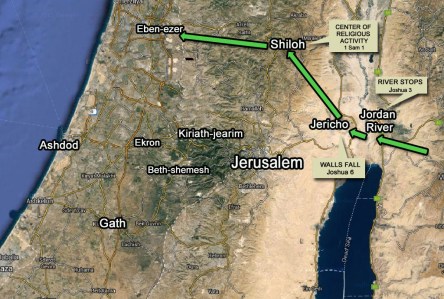

The Ark was taken by the Philistines in a place called Eben-Ezer, but eventually it came back into the possession of the Israelites which was cause for great celebration.
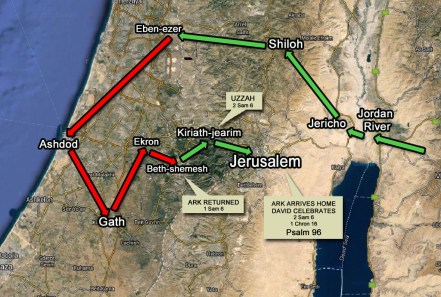
Psalm 96, which is almost word for word from 1 Chronicles 16, is what David penned during that exciting celebration of the arrival of the Ark of the Covenant in Jerusalem. The excitement propelled David to launch into the intense worship encounter that became what we read in Psalm 96:1-13.
We SING and we WITNESS. v.1-3
Because He is MAGNIFICENT and He is CREATOR. v.4-6
We SING (verse 1-2a)
Christians should place a high premium on worship. If we want to lift high the name of Jesus, we can do that through our singing. This verse says what kind of song we can sing: a NEW song! God loves new things. How about us being New creations 2 Cor 5:17? IF ANYONE IS IN CHRIST, HE IS A NEW CREATION! Or how about a new heavens and a new earth in the book of Revelation? Awesome stuff!
It’s ok to sing new contemporary songs as long as the lyrics are Biblically correct. He loves new and fresh expressions of praise.
We WITNESS (verse 2b)
Witness means to PROCLAIM what we see: Exposing beauty through announcement EVERY DAY! We must see God as incomparably beautiful. A wedding processional is a good word picture here. The bride walks down the aisle in a beautiful white dress, adorned for her new husband, proclaiming her intentions of marriage for all to see and hear. When we view God as incomparably beautiful, then we will proclaim it. Our view of God will dictate how we share the gospel.
We cannot convince others about the awesomeness of the Lord unless we’re first convinced about it ourselves. And people will not know you’re convinced unless you announce it to them.
How to throw water on the flames of evangelism:
1). No enthusiasm. Jesus just isn’t exciting to you. You find the Bible boring. You think your Christian friends are drab.
2). Being confusing or indirect. You don’t speak with clarity and conviction. You are known for beating around the bush. Who is impressed with a Jesus that we’re timid about? Who wants the Jesus that we’ve hidden because we’re ashamed?
3). Pride. Nobody cares how much you know. Seriously.
4). Hypocrisy. Nobody wants a Jesus that appears to have left you the way He found you.
How do we proclaim the gospel? Just tell your story! “I am a work in progress”.
‘Tell’ in verse 3 means simply to enumerate. To count. This is the same word as when God told Abraham to look and the sky and see if he could COUNT the stars. It is Bringing the Lord into our conversations, telling people how much He means to us:
Good Examples:
“You’ll never guess how God answered this particular prayer.”
“Let me tell you about what I just learned in scripture today.”
“We’ve been blessed by the Lord. He’s been so good to us.”
“I am so thankful God has chosen to provide for me with this job.”
“We’ve seen God do amazing things in so-and-so’s life, getting them through so much pain and suffering.”
“I love green beans, they are one of God’s greatest inventions!”
When you have opportunity to proclaim the life saving message of the gospel… JUST DO IT, because people need to know:
- that they are sinners and that sin has separated them from GOD!
- that the wages of sin is DEATH, but the FREE gift of God is eternal life in Christ Jesus.
- that if they CONFESS JESUS IS LORD and BELIEVE GOD RAISED HIM FROM THE DEAD that they will be SAVED.
- that rejection of CHRIST results in an eternal conscious punishment in a REAL place called HELL.
- that there is now NO CONDEMNATION for those who are in Christ Jesus!
He is Creator
Verse 5 is a play on words. David refers to he gods of the peoples, likely refering to Baal (sun god – human sacrifice, burnt alive), Ashtoreth(the moon-goddess – female counterpart to Baal ), Molech (children sacrificed), and Dagon (the fish god). He says they are idols. There are no less than 18 different terms for idol in the OT: words like a shame, dung, refuse, a shadow, a statue, a shape, a device, a molten image. In this passage it is the word for nothingness. Non-existent things. In other words, the people had shapen ‘nothingness’ into their gods, which in the end makes them meaningless, ineffective and… nothing. We have a few idols in our lives, don’t we? We often sink our time and resources into that which has no earthly or heaven value whatsoever.
The play on words here is that the Lord made the heavens and the earth out of… NOTHING. Unlike humans who ‘create’ their own gods with their own hands out of metal or wood, God is really the One who creates. He created everything out of nothing. We worship Him as the true Creator.
He is Magnificent
In verse 6, it speaks of God’s splendor, majesty, power and beauty: a declaration of God’s magnificent uniqueness. Who of us has ever made the lame to walk or the blind to see? This is unique to God. Have you ever done a miracle? Have you ever created rolling thunder or flashing lightning? Have you ever put a rainbow in the sky. When is the last time you made it rain or created a beautiful sunset?
We need to tell people about this amazing and magnificent God… it’s part of how we worship Him!
We ACKNOWLEDGE, we GIVE and we TREMBLE. v.7-9
Because He is SOVEREIGN and He is JUDGE. v.10
The use of the word ‘ascribe’ in this passage is humbly giving credit and acknowledgement to God for the attributes and characteristics that already belong to Him. He knows who He is and doesn’t need our affirmation because He’s forgetful or narcissistic. Reciting God’s attributes back to Him is an essential part of worship because it makes us realize how much different and separate He is from us. He is holy and deserves to be treated as such. In fact, in verse 9 we’re supposed to worship the Lord in the beauty of His holiness. His holiness sums up all of His many character attributes in one word. Holiness means set apart. None like Him. One of a kind. We tremble before such a being. This literally means a ‘leaping’ or ‘palpitation’ of the heart. Being in the presence of such a God should bring this kind of reaction in us with every encounter (unlike the fake gods mentioned above).
To this sort of awesome God, we bring an OFFERING (verse 8). This is the giving of our time, talents and treasures. When the tabernacle and all the ‘furniture’ was being constructed, the Israelites graciously contributed from willing hearts to the effort. The offering campaign did not happen through clever fund-raising techniques. People willingly brought their golden earrings, bracelets, signet rings, linens, silver, precious stones, fragrant oils, etc. Nothing was off limits! Every skilled workman and everyone whose heart stirred within them came to help with the project. A disciple of Christ, as part of their worship, should be generous with their money and with their time, investing it in the work of the Lord.
We can be generous because God is SOVEREIGN – He reigns over all. Jesus Christ is the Lord of Lord and the King of Kings. He owns the cattle on a thousand hills and when we entrust our resources to Him, He will take good care of us. Our generosity is another way to worship Him, because it acknowledges that we trust him and believe that He is who He says He is: the sovereign king of the universe.
We REJOICE and we CELEBRATE. v.11-12
Because He is RIGHTEOUS and He is FAITHFUL. v.13
The Psalm ends with overtures of rejoicing and celebration. The heavens and the earth are rejoicing and the sea is roaring! Even the fields and trees are celebrating. There is a jumping with joy! Why is this? Because there is an acknowledgment, even in nature, that God ALWAYS does what is RIGHT and ALWAYS keeps his promises. He will JUDGE the world and everything will be set right again.
Imagine standing before the JUDGE for a crime that you committed: you are utterly helpless and dependent upon Him! You are guilty. You have a certificate of debt with decrees against you. You have a rap sheet as long as your arm. But JESUS has taken this away – nailed to the cross! Is this not worthy of your best worship? Should we not be jumping for joy and celebrating? Of course! That is the only response to the God who has done such magnificent things.
Conclusion
This Psalm, combined with the events from 1 Samuel 6, teach us of unashamed worship and celebration.
From the window of their house, David’s wife Michal saw him leaping and dancing and she despised him. When David went in, Michal said “OH how the king has DISTINGUISHED himself as one of the foolish ones!” What was David’s response: “It was before the Lord, who chose me above your father’s house… therefore I will celebrate”. Because of God’s goodness, we can celebrate unashamedly, for He has done great things!
When we’ve been there 10,000 years
Bright shining as the sun
We’ve no less days to sing God’s praise
Than when we first begun.



 Establish my footsteps in Your Word ~ Psalm 119:133
Leave a comment